Silicone Rubber Material Guide: Types, Grades & How to Choose (VMQ, FVMQ, LSR, HTV & More)
Last Updated On: 2026-07-28
Silicone rubber comes in several types — VMQ for general sealing, FVMQ for oil and fuel, PVMQ for extreme cold, and processes like HTV and LSR for different volumes.
This guide explains every major type, when to use it, and how to choose the right one for your O-rings, gaskets, and custom parts.
One Material Family, Many Choices
“Silicone” is not one material. It is a family.
Two silicone O-rings can look identical — but one fails in oil within weeks, and the other lasts for years. The difference is the material type, the curing system, and the molding process.
This guide maps the whole family, so you can choose with confidence. Each section links to a full article on that topic.
Part 1: Material Types (The Base Rubber)
VMQ — Standard Silicone Rubber
The workhorse. When a drawing just says “silicone,” it means VMQ.
→ Full guide: What Is VMQ Silicone Rubber?
FVMQ — Fluorosilicone
Silicone that is not afraid of oil. Fluorine added to the polymer chain gives excellent oil, fuel, and solvent resistance.
→ Full guide: Fluorosilicone (FVMQ): Oil & Fuel Resistant Silicone Explained
PVMQ & PMQ — Low-Temperature Silicone
Phenyl groups added to the chain keep the rubber flexible down to -100°C.
Specialty Grades
Grade | What It Adds | Used For |
|---|---|---|
Conductive silicone | Carbon or silver fillers | EMI shielding gaskets |
Flame-retardant silicone | UL94 V-0 rating | Electronics, enclosures |
Fiberglass-reinforced silicone | Fabric layer for strength | High-pressure gaskets, pads |
Silicone foam / sponge | Closed-cell structure | Cushioning, thermal insulation |
High-temperature grade | Heat stabilizers | Continuous 250°C applications |

Part 2: Curing Systems (How the Rubber Is Cross-Linked)
The same base silicone can be cured two ways:
Platinum-Cured (Addition Cure)
→ Full guide: Platinum-Cured vs Peroxide-Cured Silicone
Peroxide-Cured
Simple rule: touches food, water, or the human body → platinum. Everything else → peroxide is usually the smarter buy.
Part 3: Molding Processes (How Parts Are Made)
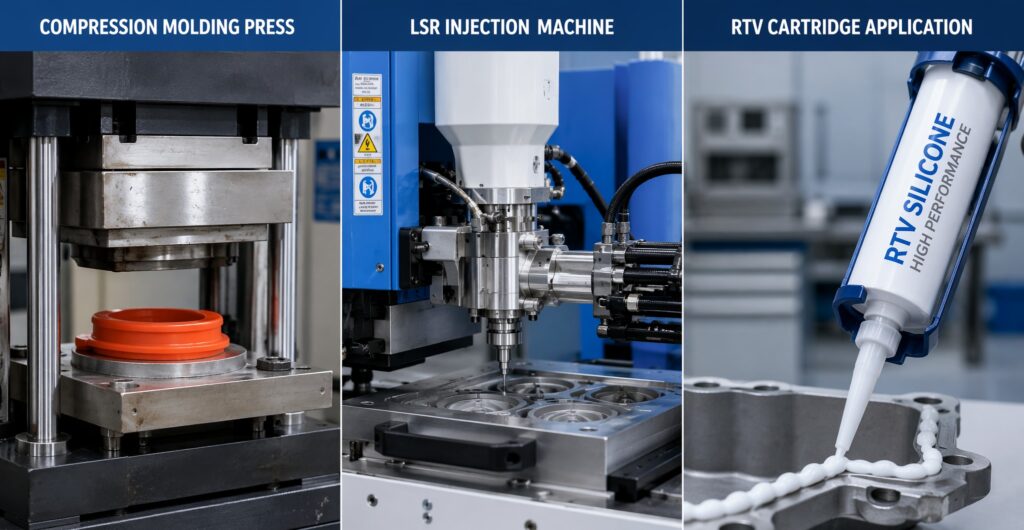
→ Full guide: HTV vs LSR Silicone: Which Molding Process Fits Your Parts?
HTV / HCR — Solid Silicone
Solid rubber, compression or transfer molded.
LSR — Liquid Silicone Rubber
Two-part liquid, injection molded, always platinum-cured.
RTV — Room Temperature Vulcanizing
Cures without heat, usually applied as a paste. Used for form-in-place gaskets and on-site sealing — a different product category from molded parts.

→ Full walkthrough with charts: Silicone O-Ring Material Selection Guide
Part 4: How to Choose — The 4-Step Method
Answer four questions and the right material picks itself:
1. What does the seal touch?
2. How hot or cold?
3. What certification do you need?
4. How many parts?
Master Comparison Table
Options | VMQ | FVMQ | PVMQ | LSR (process) |
|---|---|---|---|---|
Temperature | -60 to +200°C | -60 to +175°C | -100 to +180°C | Same as VMQ |
Oil / fuel resistance | Poor | Excellent | Poor | Depends on base |
Food / medical grade | Yes (platinum) | No | Yes (platinum) | Yes (standard) |
Cost | Low | High | Medium–High | High tooling, low unit |
Best volume | Any | Any | Any | 100K+ |
Typical parts | O-rings, gaskets | Fuel seals | Cold-climate seals | Medical parts, micro parts |
Tips from ZSR: Save this table. When a customer or colleague asks “which silicone?”, nine times out of ten the answer is already here.
Common Mistakes to Avoid
FAQs
Get Material Advice From the Manufacturer
ZSR is a silicone rubber manufacturer. We help engineers and buyers choose the right material before cutting any steel — free of charge.
Send your drawing, sample, or working conditions. Material recommendation and quote within 24 hours.
In this guide series: What Is VMQ Silicone Rubber? · Fluorosilicone (FVMQ) Explained · Platinum-Cured vs Peroxide-Cured Silicone · HTV vs LSR Silicone · Silicone O-Ring Material Selection Guide