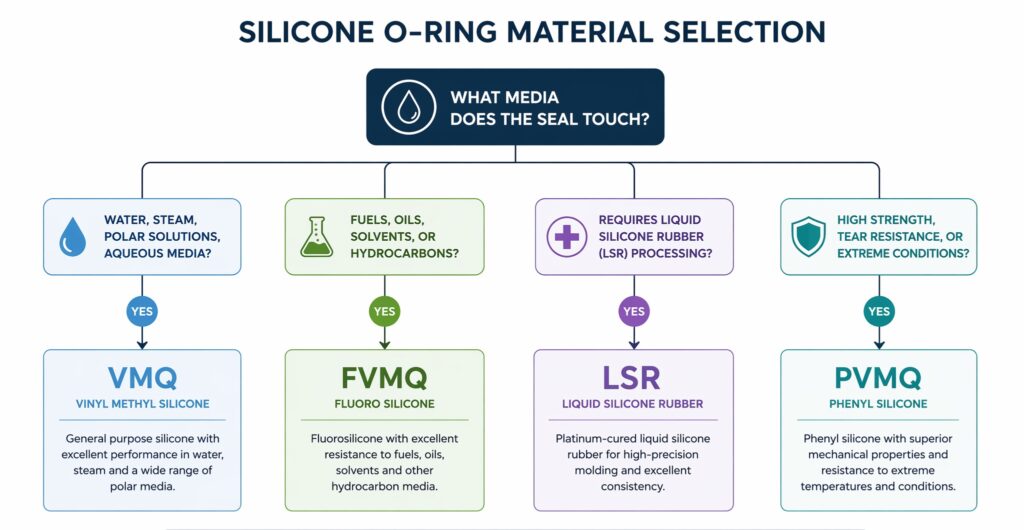
Choosing a silicone O-ring material comes down to three questions:
What does the seal touch? How hot or cold does it get?
Does it need food or medical certification?
Answer these, and the right material — VMQ, FVMQ, or LSR — usually picks itself.
Why Material Selection Matters
All silicone O-rings look similar. But the wrong material choice is the #1 reason silicone seals fail early:
Ten minutes of material selection saves months of trouble.
Step 1: What Does the Seal Touch?
This is the first and most important question.
Media | Recommended Material |
|---|---|
Air, water vapor, general environment | VMQ (standard silicone) |
Food, drinking water, body contact | Platinum-cured VMQ |
Oil, fuel, grease, solvents | FVMQ (fluorosilicone) |
Hot water or steam (long-term) | Silicone is the wrong choice — ask about EPDM |
Tips from ZSR: “The seal touches oil sometimes” counts as oil contact. Occasional splash is enough to damage standard VMQ over time. When in doubt, tell us — we check compatibility for free.
Step 2: What Is the Temperature?
Condition | Recommended Material |
|---|---|
-60°C to +200°C | VMQ or FVMQ (both handle this) |
Below -60°C (down to -100°C) | PVMQ (phenyl silicone) |
Oil + extreme cold (below -20°C) | FVMQ — often the only option |
Short peaks up to 230°C | VMQ (verify with your supplier) |
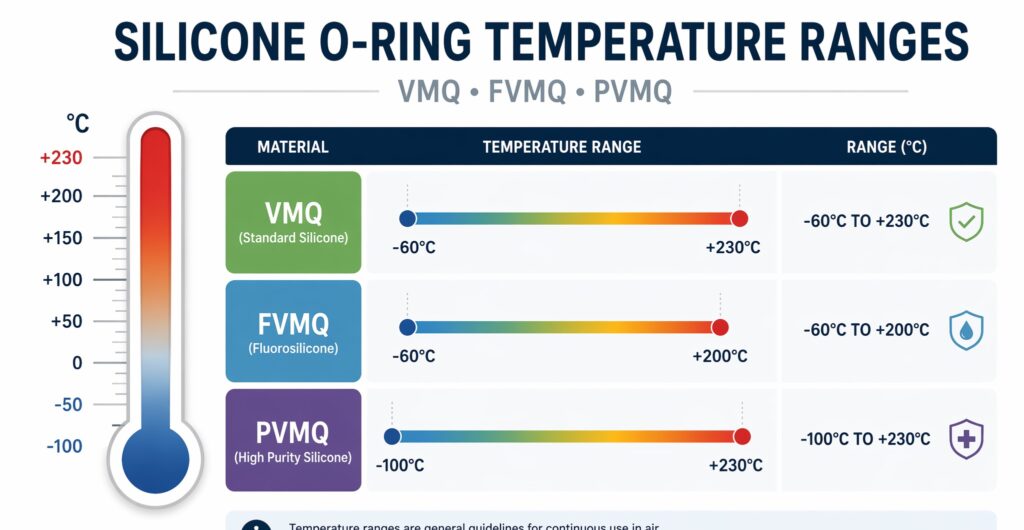
Silicone’s wide temperature range is its biggest strength. If your seal lives outdoors, in a freezer, or near an oven, silicone is usually on the shortlist.
Step 3: Do You Need Certification?
Requirement | Material & Process |
|---|---|
FDA 21 CFR 177.2600 (food contact) | Platinum-cured VMQ |
USP Class VI (medical) | Platinum-cured VMQ, often LSR-molded |
EU 1935/2004 | Platinum-cured VMQ |
General industrial, no certification | Peroxide-cured VMQ — the economical choice |
Step 4: Choose the Process (HTV vs LSR)
Once the material is set, pick how the O-ring is made:
Read the full comparison: HTV vs LSR Silicone
The Complete Selection Chart
Your Situation | Best Choice |
|---|---|
General seal, air or mild environment | Peroxide-cured VMQ, 70 Shore A |
Food machine or drinking water | Platinum-cured VMQ, FDA grade |
Medical device, high volume | Platinum-cured LSR, USP Class VI |
Fuel or oil line, any temperature | FVMQ |
Outdoor seal, extreme cold below -60°C | PVMQ |
Rough flange, low bolt force | Softer VMQ (50–60 Shore A) |
Steam or hot water | Not silicone — ask about EPDM |
Don’t Forget Hardness
Material is only half the spec. Hardness matters just as much:
Advice from ZSR: If you are copying an old part and do not know its hardness, send us the sample. We measure hardness and compression set in our lab, then match or improve the spec.
Common Selection Mistakes We See
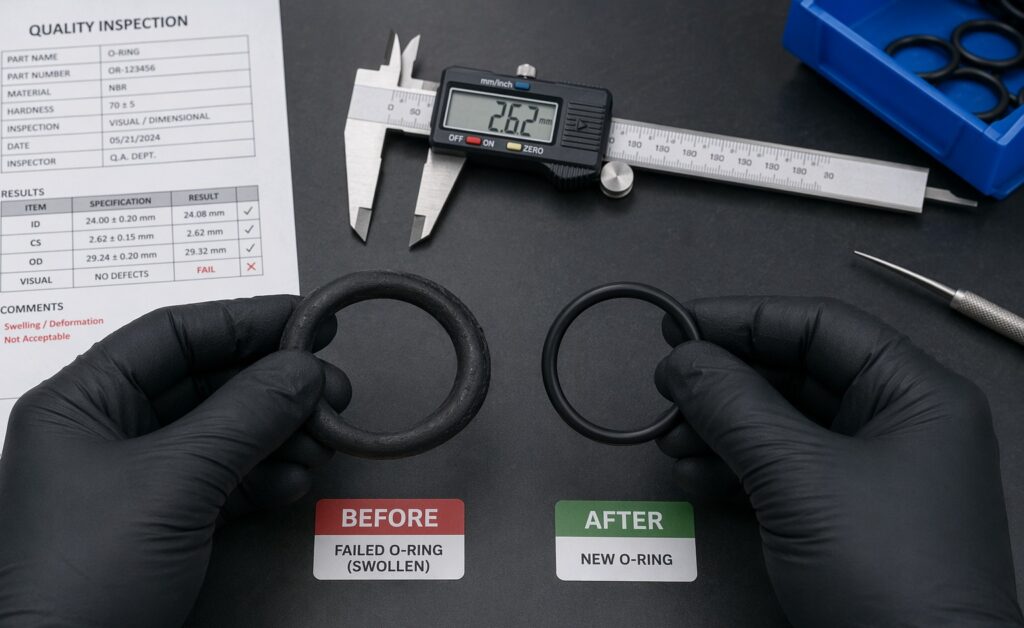
- Specifying “silicone” without the cure type — food-grade parts need platinum cure in writing.
- Using VMQ in oil because “it is just a little splash” — switch to FVMQ.
- Copying an FKM spec into a cold environment — FKM stiffens below -20°C; use FVMQ.
- Choosing LSR for 5,000 parts — tooling cost kills the budget; HTV is fine.
- Forgetting compression set — for seals that stay compressed for years, ask for low-compression-set compound.
FAQ
Not Sure Which Material You Need?
Material selection is free at ZSR. Tell us three things — what the seal touches, the temperature range, and your annual quantity — and we will recommend the right material, cure system, and process.
Send your requirements. Answer within 24 hours.
Related reading: What Is VMQ Silicone Rubber? | Fluorosilicone (FVMQ) Explained | Platinum-Cured vs Peroxide-Cured Silicone | HTV vs LSR Silicone