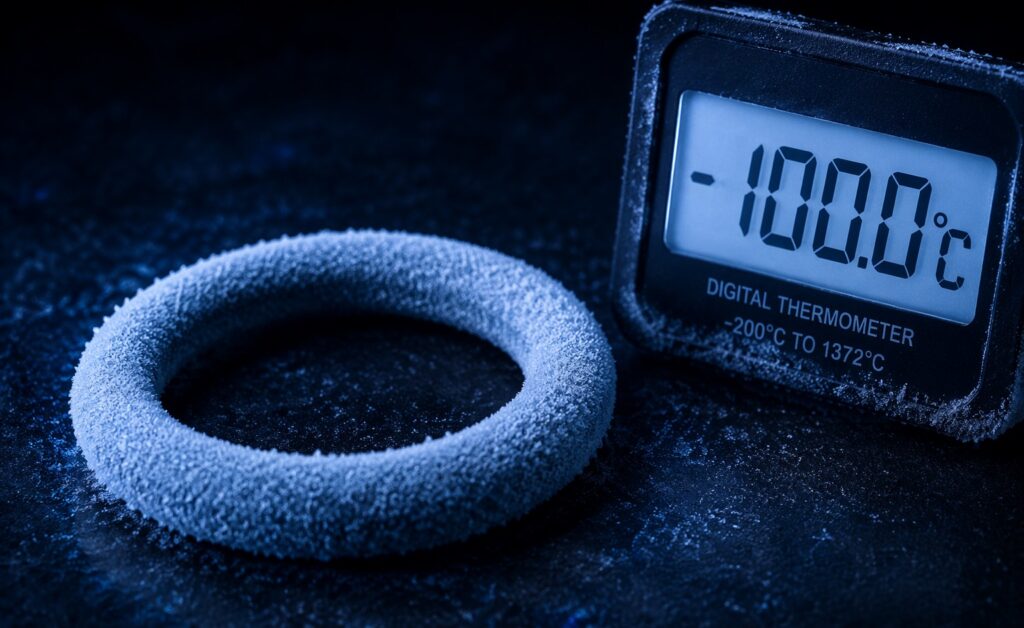
PVMQ (phenyl silicone) stays flexible down to -100°C — far below standard silicone’s -60°C limit.
It is the material engineers choose when seals must work in extreme cold: aerospace, arctic equipment, and outdoor systems that face deep-freeze conditions.
What Are PMQ and PVMQ?
Both are members of the silicone family with phenyl groups added to the polymer chain:
Standard silicone (VMQ) is built from methyl and vinyl groups. Replacing some methyl groups with larger phenyl groups stops the rubber from crystallizing in extreme cold. The result: flexibility where other rubbers — and even standard silicone — turn hard and brittle.
In practice, when someone says “low-temperature silicone,” they usually mean PVMQ.
Why Cold Is a Problem for Rubber
Rubber seals work because they are flexible. Cold attacks this in two ways:
- Glass transition — below a certain temperature, rubber becomes glass-like and cracks.
- Crystallization — standard silicone slowly crystallizes around -50°C to -60°C and stiffens, even before glass transition.
A stiff O-ring cannot follow the surface it seals. The result is leakage — often only discovered when the equipment reaches the cold environment.
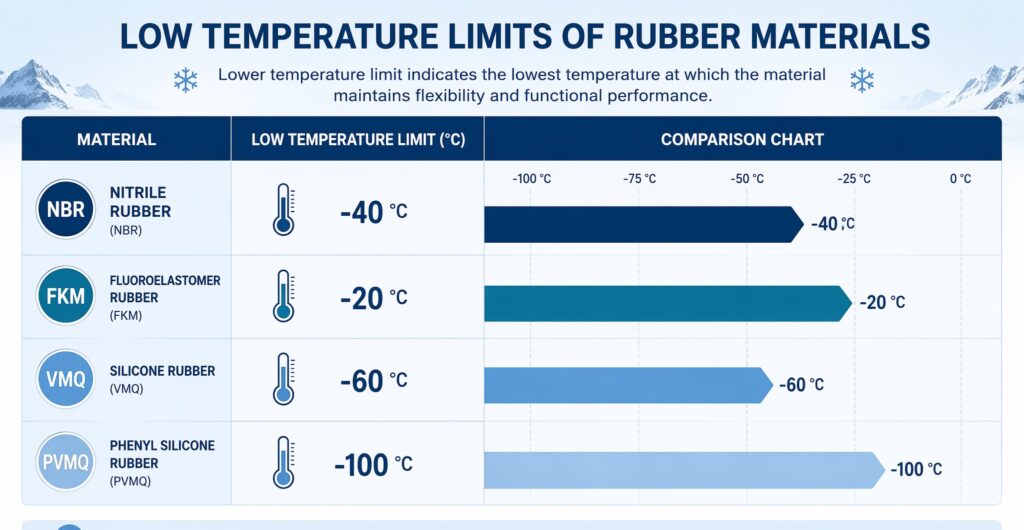
Material | Practical Low-Temperature Limit |
|---|---|
NBR (Nitrile) | about -30°C |
FKM (Viton®) | about -20°C |
VMQ (standard silicone) | about -60°C |
PVMQ (phenyl silicone) | about -100°C |
Key Properties of PVMQ
Property | Typical Value |
|---|---|
Temperature range | -100°C to +180°C (compound dependent) |
Hardness | Shore A 40 to 80 |
Compression set at low temp | Good |
Weather / ozone / UV resistance | Excellent |
Oil & fuel resistance | Poor (same as VMQ) |
Cost | Higher than VMQ |
Tips from ZSR: The exact low-temperature limit depends on the phenyl content of the compound. If your spec says “-100°C service,” tell us at inquiry — we select the compound grade to match, not just the material family.
Where PVMQ Is Used
Where PVMQ Is NOT Needed
Advice from ZSR: Check your real minimum temperature — not the worst case on paper, but what the seal actually experiences. Many “-100°C specs” we review turn out to be -55°C in reality, which standard VMQ handles at a fraction of the cost. We help you verify before you buy.
PVMQ vs VMQ vs FVMQ: Quick Comparison
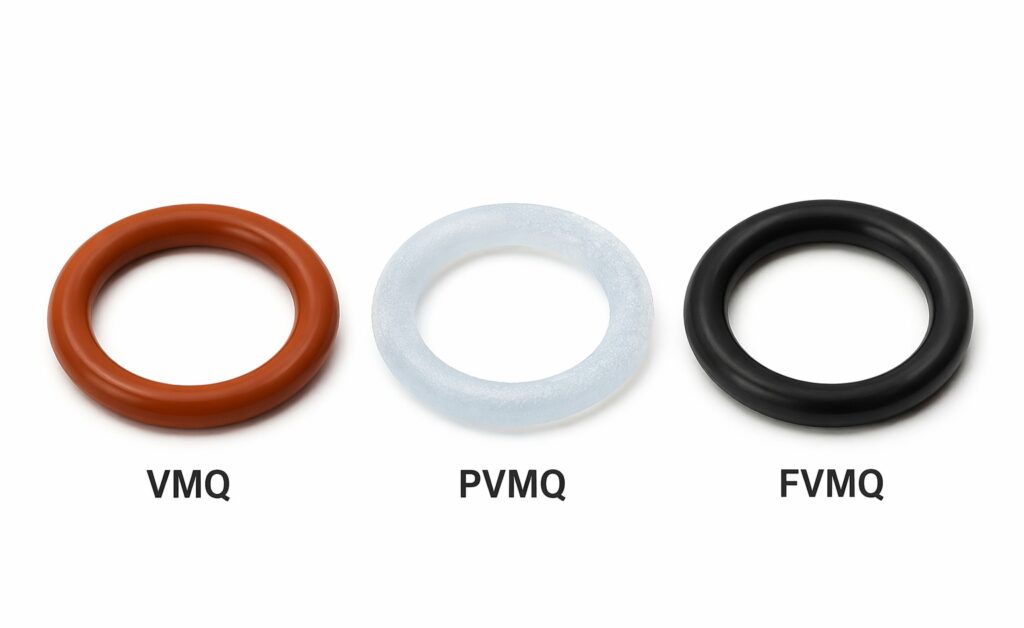
VMQ | PVMQ | FVMQ | |
|---|---|---|---|
Low temp limit | -60°C | -100°C | -60°C |
High temp limit | +200°C | +180°C | +175°C |
Oil / fuel resistance | Poor | Poor | Excellent |
Cost | Low | Medium–High | High |
Best use | General sealing | Extreme cold | Oil + cold |
FAQ
Need Seals for Extreme Cold?
ZSR molds low-temperature PVMQ silicone parts in-house. Tell us your real working temperature and environment — we will recommend the most cost-effective material that actually meets your spec.
Send your requirements. Answer within 24 hours.
Related reading: What Is VMQ Silicone Rubber? | Fluorosilicone (FVMQ) Explained | Silicone O-Ring Material Selection Guide | Silicone Rubber Material Guide