Custom Silicone Mold Design & Making Service
Get custom silicone rubber tooling with our Tooling design & Making Service in 15-30 days.
ISO 9001:2015 Certified
SA8000 / SEDEX 4P
Prototype to Mass Production
15–30 Day Lead Time
Z.S.R silicone molds/tooling Capacities
Mold Cavity Tolerances
±0.05 mm when machining, the mold and an additional ±0.128 mm when calculating for shrink rate
Mold/Tooling
10-50pcs; Production Tooling lifecycle: over 50,000 cycles
Part-to-Part Repeatability
2-20 mm
Available size
1MM-650MM
Max available colors in one product
Less than 6 colors
Critical Feature Tolerances
Tighter tolerances can be requested and may increase the cost of tooling because of additional sampling and grooming. Z.S.R will mill to a steel-safe condition on critical features.
Available Mold Types
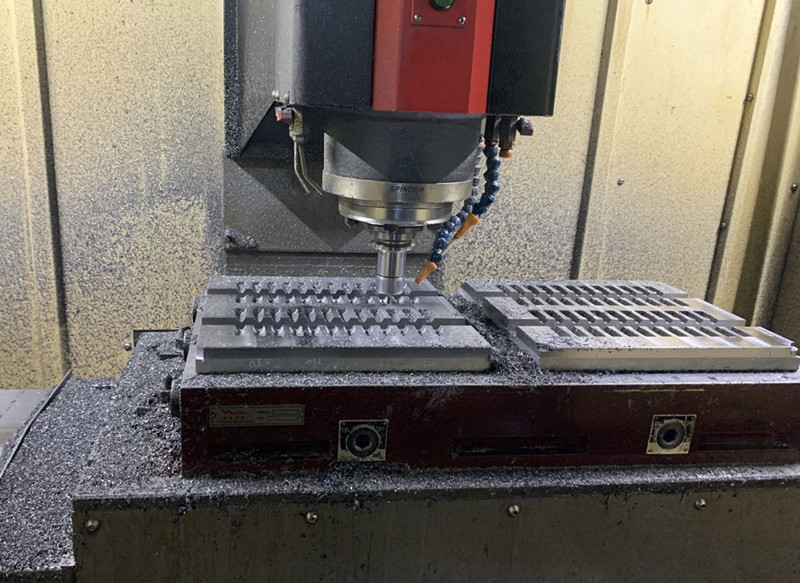
Copper, Steel (tool steel, carbon steel) and aluminum; Production grades range from Class S50C a prototype mold, to Class P20, an extremely high production mold.
After your files are received, we’ll review them to identify and communicate any potential Design for Manufacturability (DFM) Feedback to save money through the tooling/mold manufacturing process.
Advantages & Benefits of using steel to silicone molds/tooling:
Supplied in a Pre-hardened State; No Secondary Heat Treatment Required
P20 steel is supplied with a factory hardness of 28–32 HRC (approximately 330–370 HB). It can be used directly for mold machining, thereby shortening production cycles and reducing costs.
Excellent Polishability and Surface Finish
It possesses superior mirror-polishing capabilities, making it suitable for applications where the surface quality of silicone products is critical—such as in daily consumer goods, home appliance components, and similar items.
Outstanding Machinability and Dimensional Stability
Characterized by a dense microstructure and uniform composition, the material is easy to machine via CNC processes. Furthermore, it exhibits minimal deformation during heat treatment, which helps ensure high mold precision and product consistency.
High Economic Efficiency and Outstanding Value
Compared to high-end mold steels such as 718, NAK80, and S136, this material offers lower costs, making it ideal for medium-to-small batch silicone mass production requirements (100,000–500,000 cycles).
Extended Lifespan Through Nitriding
Following nitriding treatment, the surface hardness can reach 650–700 HV (approximately 57–60 HRC). This boosts the mold’s lifespan to over 1 million cycles while simultaneously enhancing its corrosion resistance and mold-release properties.
Broad Applicability
Widely utilized in silicone compression molds, hot-press molds, and similar applications. It is particularly well-suited for silicone products with relatively simple structures, moderate production volumes, and standard surface finish requirements (e.g., toys, gifts, industrial components, etc.).
Production Volume & Budget Considerations
Production Volume:
50,000–100,000 cycles (standard mass production); can reach 1 million+ cycles after nitriding.
Product Requirements:
Standard matte or general-finish surfaces; not intended for high-precision mirror finishes.
Note: If the silicone formulation contains strong acids, strong bases, or highly abrasive fillers, it is recommended to apply a hard chrome plating or opt for a more corrosion-resistant steel grade (such as S136).
Types of Silicone Molds/Tooling
Z.S.R. offers two types of custom silicone mold/tooling: HCR Silicone compression molds/tooling and LSR molds/tooling. While both processes are great options, your part geometry and complexity will likely determine which process to use.
HCR Silicone Compression Molding | LSR Injection Molding |
|---|---|
Suitable for manufacturing silicone products with well-defined structures and moderate complexity, such as O-rings, gaskets, buttons, and tableware. | Suitable for manufacturing silicone products with high precision and complex geometries, such as medical seals, automotive connector gaskets, etc |
Material Choose Solid silicone (HCR/HTV), peroxide or platinum cure | Material Choose Two‑part liquid silicone (LSR), platinum-catalysed |
Typical mold steel Aluminium/steel (lower cost, faster machining) | Typical mold steel Precision tool steel (higher hardness, longer lead time) |
Mold lead time 2–3 weeks | Mold lead time 4–6 weeks |
Mould life 50,000 – 100,000+ shots | Mould life 500,000 – 1,000,000+ shots |
Part price (100 pcs) Low | Part price (100 pcs) High |
Part price(100k+ pcs) Medium | Part price(100k+ pcs) Very low |
MOQ 50 to 100 pcs | MOQ 5,000–10,000 pcs |
Achievable tolerance ±0.10 – 0.20 mm | Achievable tolerance ±0.01 – 0.03 mm |
Surface finish Cut or vapour‑honed | Surface finish Spark eroded + polished |
Max size ≥ 500+ mm | Max size ≤ 300 mm |
Minimum size ≥ 0.5 mm | Minimum size ≥ 0.05 mm |
Hardness 30–80 | Hardness 20–70 |
Delivery Time 5–10 working days | Delivery Time 2–5 working days |
Quality Conforms to drawing, visually acceptable (flashing removed) | Quality 100% flash‑free, process capability Cpk ≥ 1.33 |
Service Detail
| Service Detail
|
Surface Finish
- HCR compression parts often retain mould texture but may have minor parting-line witness marks and require deflashing, which can affect the local finish.
- LSR injection moulds are polished to higher grades; parts can be optically transparent, glossy, or textured exactly as specified, with no manual touch‑up.